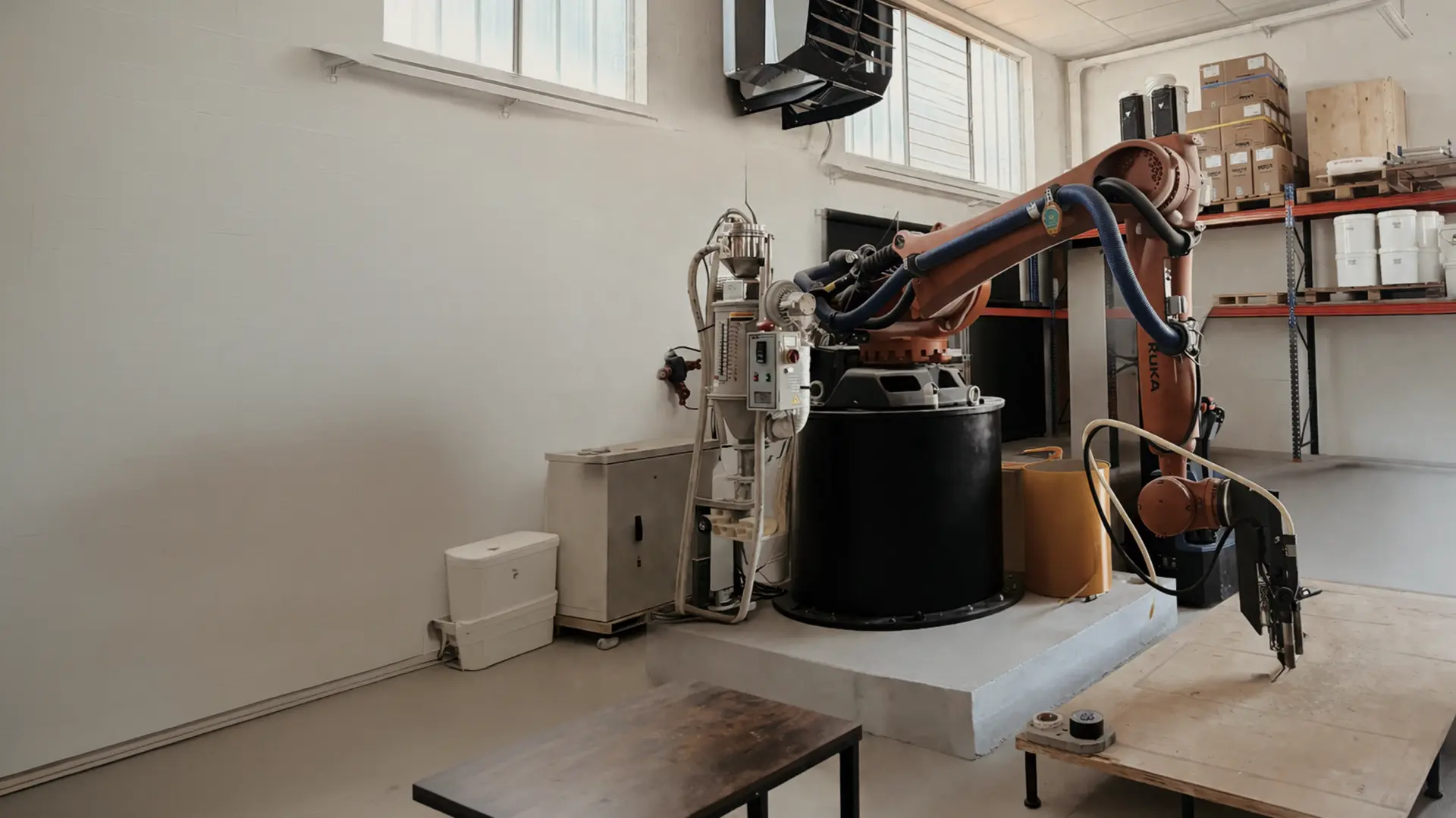
Large format robotic 3D printing cell with KUKA arm and pellet extruder
[Technology Applications]

Applied Across Industries

One robotic process, many industries. Below is how large format additive manufacturing is being applied today.

Open any industry to see what we print, and why it beats the traditional route.

Industry applications for large format additive manufacturing

Design and Furniture — large format additive manufacturing application
Design and Furniture

Furniture and interiors run on long lead times, tooling budgets and minimum order quantities that punish anything short of mass production. Printing direct from a digital model removes all three, so a single piece costs roughly what a hundred would per unit — and a design can change between one build and the next at no cost.

  • No tooling amortisation — economics work at a batch of one, so bespoke and limited-run collections become commercially viable
  • Weeks, not months: concept to full-scale piece typically inside a fortnight, letting studios respond to a fit-out programme rather than lead it
  • Design freedom pays — complex, geometry-led forms cost the same to print as simple ones, so the value sits in the design rather than the machining
  • Produced in Ireland from recovered polymer, with a documented recycled content story that supports specification on sustainability-led projects
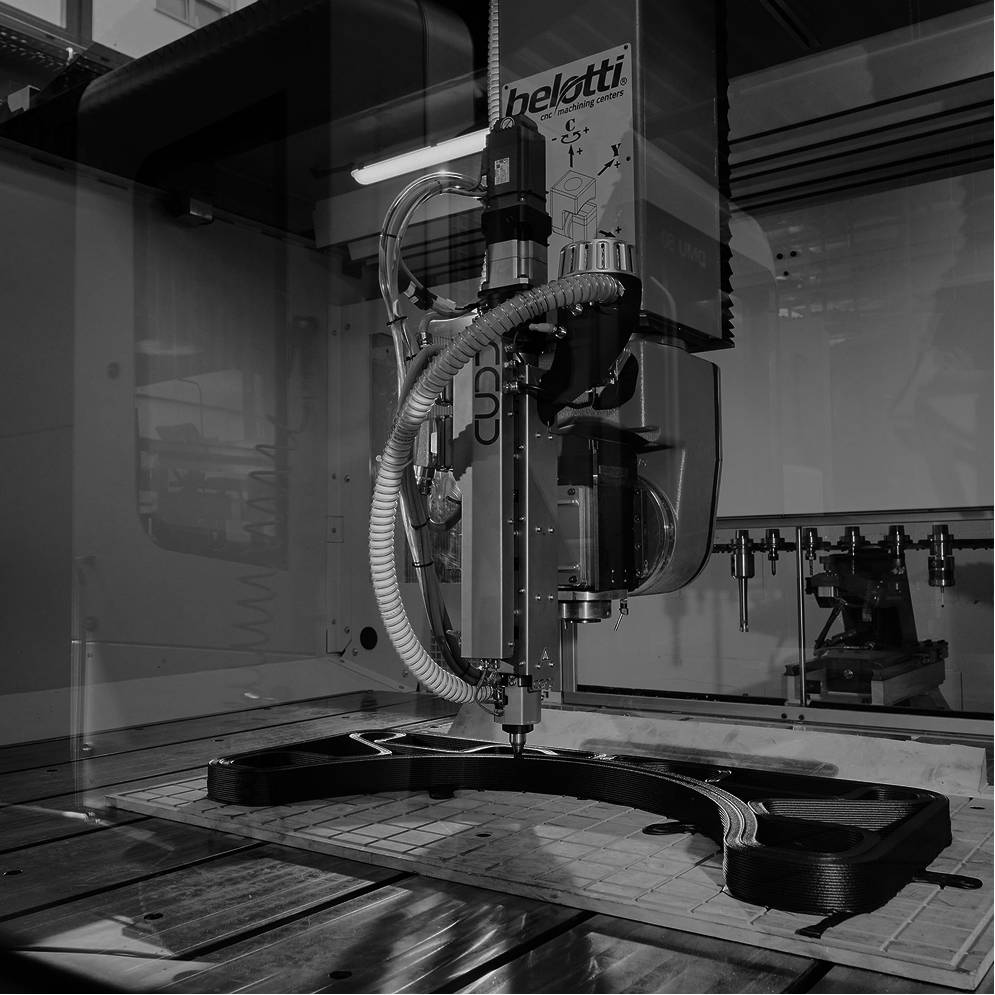
Industrial Tooling — large format additive manufacturing application
Industrial Tooling

Tooling is usually the longest and least flexible line on a manufacturing programme. Printing jigs, fixtures, moulds and forming tools compresses that lead time to days and moves the spend from capital-heavy machining to a variable, per-part cost that can be revised as the process matures.

  • Typical 60–90% reduction in tooling lead time against machined aluminium or CNC-cut board, pulling forward the whole production schedule
  • Low cost of change — iterate a fixture between shifts instead of living with a compromise for the life of the programme
  • Lighter tools mean safer manual handling, faster changeovers and less crane and jig-store overhead on the floor
  • End-of-life tools are shredded and reprinted, turning a disposal cost into feedstock for the next build
Architecture and Construction — large format additive manufacturing application
Architecture and Construction

Bespoke building elements are expensive because every one-off needs its own mould or formwork, most of which is skipped once. Printing the element — or the mould — at true architectural scale removes that sunk cost and gives design teams geometry they would otherwise value-engineer out of the drawings.

  • Single-use formwork replaced by printed moulds that can be reused, reworked or recycled — removing the waste stream and its disposal cost
  • Panel-by-panel variation at no cost premium, so parametric façades and shading systems survive to construction rather than being simplified
  • Shorter, more predictable procurement for non-standard elements, reducing the programme risk that usually drives specification back to standard product
  • Recycled-content components and local manufacture contribute to embodied carbon targets and public-sector sustainability criteria
Energy — large format additive manufacturing application
Energy

In energy, the cost of a part is trivial next to the cost of the asset standing idle. Digital inventory and on-demand printing shorten the gap between a failure and a fix, and let operators support ageing or obsolete equipment without holding capital in slow-moving spares.

  • Downtime-led economics — a part printed in days instead of sourced in months protects revenue that dwarfs the component cost
  • Digital spares inventory: hold the file, not the shelf stock, and print obsolete or low-volume items on demand
  • Site-specific repair tooling, formers and inspection fixtures made to suit the actual asset rather than the drawing
  • Polymer enclosures and ducting that will not corrode in coastal and exposed environments, extending replacement intervals
Aerospace — large format additive manufacturing application
Aerospace

Aerospace tooling and ground support equipment are low volume, high value and heavily iterated — exactly where conventional metal fabrication is least efficient. Large format printing cuts both the cost and the mass of that hardware while keeping change cheap through the development cycle.

  • Metre-plus layup mandrels, trim and drill tools at a fraction of the cost and lead time of machined metal equivalents
  • Significant weight reduction in handling and transport fixtures, improving ergonomics and reducing lifting-equipment requirements
  • Cheap iteration between design reviews keeps tooling in step with a maturing part rather than locking it early
  • Short-run and legacy programme support without committing to hard tooling that may never be amortised
Marine — large format additive manufacturing application
Marine

Boatbuilding still carries the cost of plugs and patterns that are built once, used once and skipped. Printing them directly from the hull model removes weeks of pattern-making labour, and printed polymer components sidestep the corrosion maintenance that drives whole-life cost in a marine environment.

  • Full-size plugs and patterns printed straight from the hull model, removing the most labour-intensive stage of a new build
  • Corrosion-free deck hardware, fairings and housings that cut recurring maintenance and replacement spend over the vessel's life
  • Custom refit and one-off components economic at a batch of one, matched to vessels that were never standard to begin with
  • Aquaculture and harbour components produced from recovered marine plastics, closing a waste stream the sector already owns

Don't see your industry? Let's print it anyway.

Talk to us about your industry